

Your email subject line has exactly 2-3 seconds to capture attention in a crowded inbox. In those crucial moments, your subject line either opens the door to engagement or sends your carefully crafted email straight to the digital graveyard of unopened messages.
The challenge is that traditional subject line optimization relies on guesswork and outdated best practices. What worked five years ago may now trigger spam filters or fail to resonate with mobile-first audiences. Our AI-powered subject line tester changes this dynamic by analyzing 50+ performance factors in real-time, providing data-driven insights that transform your email marketing results.
Table of Contents
The Science Behind Subject Line Performance
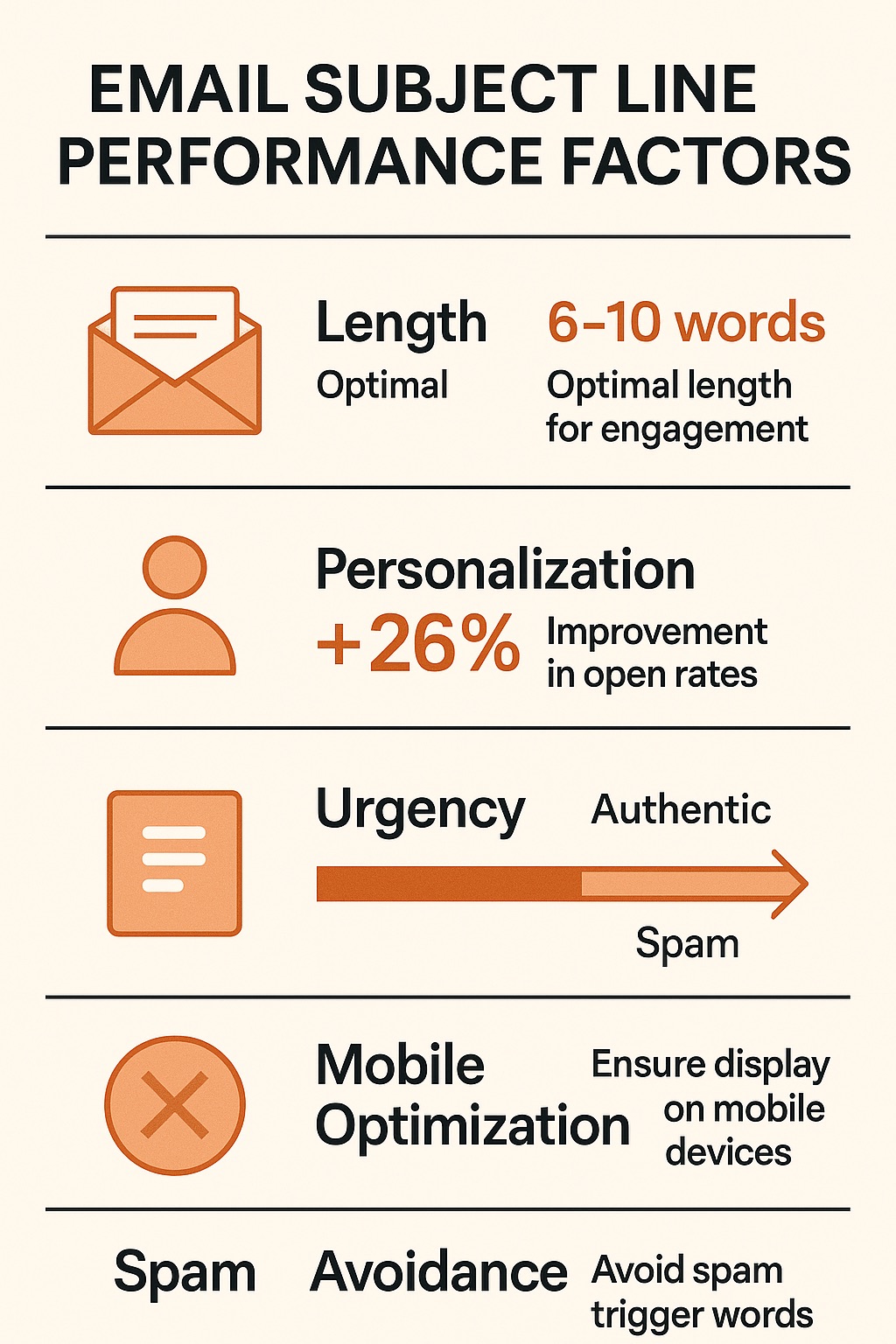
Understanding the psychological and technical factors that drive email opens enables strategic optimization that goes beyond surface-level tweaks to address fundamental engagement drivers.
Open Rate Impact Statistics
Subject lines determine 47% of email open decisions – This statistic underscores the critical importance of subject line optimization, as nearly half of your email’s success depends entirely on this single element.
Mobile users scan subject lines in 2-3 seconds average – The modern inbox experience demands immediate impact, requiring subject lines that communicate value instantly without requiring careful reading or interpretation.
Personalized subject lines improve open rates by 26% on average – Strategic personalization goes beyond inserting names to include location, purchase history, and behavioral triggers that create genuine relevance.
Poor subject lines can reduce deliverability by triggering spam filters – Technical optimization prevents your emails from reaching inboxes at all, making subject line compliance as important as engagement optimization.
Psychological Factors in Subject Line Success
Curiosity gap creation and psychological completion tendency leverages fundamental human psychology where incomplete information creates mental tension that demands resolution through email opening.
Urgency and scarcity triggers (when used authentically) tap into loss aversion psychology, but effectiveness requires genuine time sensitivity rather than manufactured pressure that trains recipients to ignore urgency claims.
Social proof and authority signal integration builds trust and credibility through language that positions your brand as a reliable source of value and expertise.
Personalization and relevance perception by recipients creates the impression of individual attention and custom communication, even within mass email campaigns.
How Our AI-Powered Subject Line Tester Works
The tool combines machine learning algorithms with email marketing expertise to provide comprehensive analysis that identifies optimization opportunities across multiple performance dimensions.
Advanced Scoring Algorithm Methodology
Machine learning analysis of 50+ performance factors evaluates elements from character count to emotional triggers, creating comprehensive scores that predict performance more accurately than single-factor analysis.
eCommerce industry-specific optimization and benchmarking ensures recommendations align with proven strategies for product-focused email campaigns rather than generic email marketing advice.
Real-time performance prediction with confidence intervals provides realistic expectations for optimization impact while accounting for audience and industry variations.
Historical email performance correlation for accuracy validation continuously improves algorithm accuracy through actual campaign performance data rather than theoretical optimization principles.
Multi-Factor Analysis Components
Length optimization for mobile email clients (Gmail, Apple Mail) ensures subject lines display effectively across different platforms while maximizing visible character space for key messaging.
Emotional trigger word identification and effectiveness scoring balances engagement-driving language with professional credibility and spam filter avoidance.
Spam filter risk assessment and alternative suggestion prevents deliverability issues while maintaining persuasive impact through compliant language alternatives.
Personalization opportunity detection and implementation guidance identifies specific areas where dynamic content can improve relevance without requiring complex technical implementation.
Key Tool Features and Capabilities
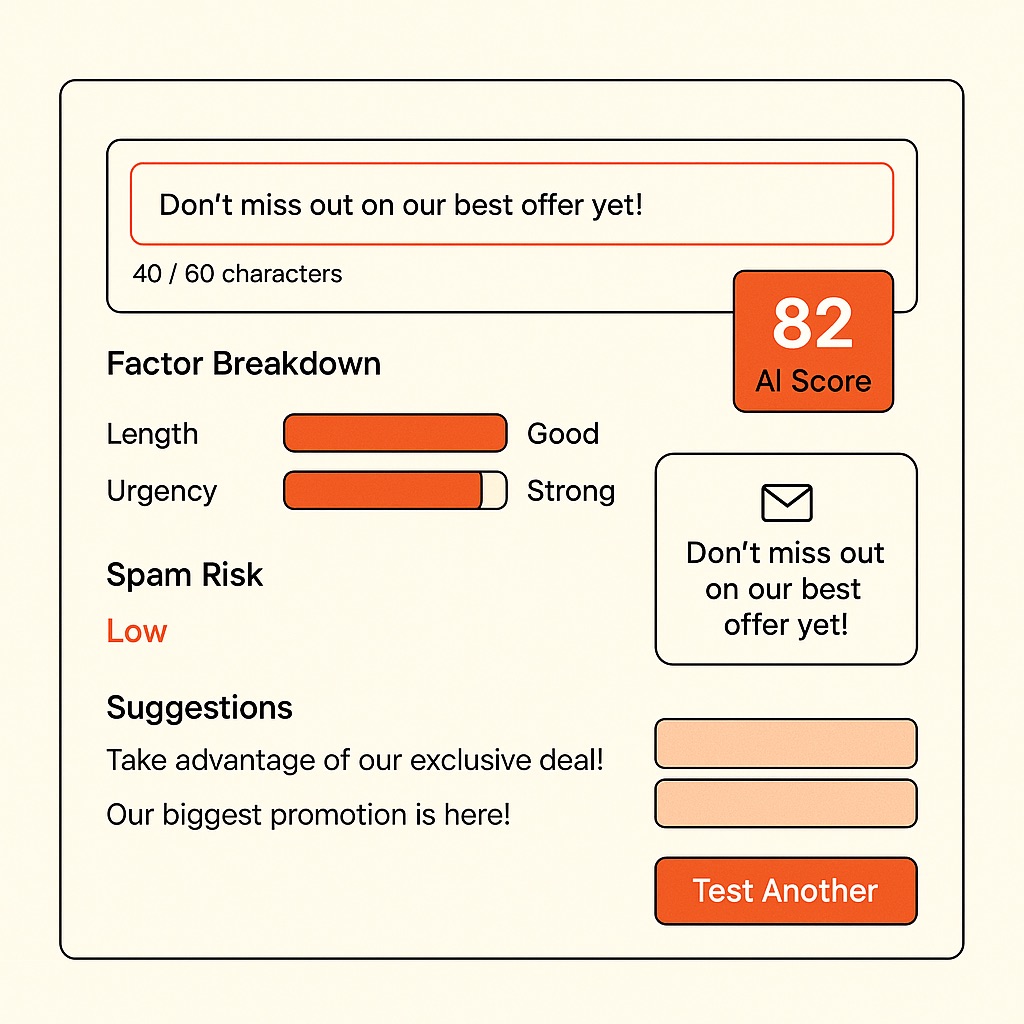
The subject line tester provides comprehensive analysis tools that address every aspect of subject line optimization from initial creation through A/B testing implementation.
Real-Time Analysis and Scoring
Instant 0-100 performance score with detailed explanations provides immediate feedback that enables rapid iteration and optimization without waiting for campaign results.
Factor-by-factor breakdown with specific improvement recommendations identifies the exact elements that limit performance while providing actionable steps for enhancement.
Mobile truncation preview across major email clients shows how subject lines appear on different devices and platforms, preventing optimization for one client at the expense of others.
Character count optimization for platform-specific limits balances comprehensive messaging with technical constraints across Gmail, Outlook, Apple Mail, and mobile apps.
A/B Testing Integration and Setup
Alternative subject line generation for systematic testing creates variations that test specific psychological and technical factors rather than random alternatives.
Statistical significance calculator for test duration planning ensures tests run long enough to produce reliable results while avoiding unnecessarily extended testing periods.
Performance prediction ranges for realistic expectation setting helps plan testing strategies and interpret results within appropriate context for your audience and industry.
Split test setup recommendations and best practices guides proper test implementation to ensure reliable results and meaningful optimization insights.
eCommerce Subject Line Optimization Strategies
Different email campaign types require distinct optimization approaches that align subject lines with recipient expectations and campaign objectives.
Campaign Type-Specific Optimization
Welcome Series: Curiosity focus (“Your journey starts here”) vs benefit focus (“Save 20% inside”) – New subscribers respond differently to intrigue versus immediate value, requiring testing to determine optimal approach for your audience.
Promotional Campaigns: Urgency balance (“24 hours left”) with benefit clarity (“50% off bestsellers”) – Sale emails must communicate both time sensitivity and value proposition without triggering spam filters through excessive urgency language.
Abandoned Cart: Gentle approach (“Forgot something?”) vs incentive approach (“Complete & save 15%”) – Recovery emails balance relationship preservation with conversion motivation, requiring careful tone calibration.
Re-engagement: Value demonstration (“We miss you – here’s 25% off”) vs curiosity (“See what’s new”) – Inactive subscribers need different motivation than engaged recipients, often requiring stronger incentives or fresh perspectives.
Industry-Specific Best Practices
Fashion/Lifestyle: Trend-focused language and seasonal relevance – Style-conscious audiences respond to fashion terminology and seasonal positioning that demonstrates industry expertise and current awareness.
Health/Wellness: Benefit-driven messaging with authority positioning – Health-focused products require credible, benefit-focused language that avoids medical claims while communicating genuine value.
Technology: Feature highlights and problem-solving focus – Tech audiences appreciate specific functionality mentions and clear problem-solution positioning rather than emotional appeals.
Home/Garden: Seasonal relevance and lifestyle integration themes – Home improvement and gardening products benefit from seasonal timing and lifestyle enhancement positioning.
Advanced Optimization Techniques
Sophisticated optimization approaches address the technical and psychological complexities of modern email marketing while maintaining scalable implementation approaches.
Mobile-First Subject Line Strategy
Character limit optimization: 30-40 characters for mobile preview – Mobile email clients truncate subject lines aggressively, requiring front-loaded messaging that communicates value within severe space constraints.
Front-loading critical information to avoid truncation places the most important elements first while ensuring that partial subject lines still communicate value effectively.
Emoji usage guidelines and platform compatibility considerations balance visual impact with professional credibility while ensuring consistent display across different email clients and devices.
Mobile-specific psychological triggers and behavior patterns account for different usage contexts where mobile users typically scan quickly during brief attention windows.
Personalization and Dynamic Content Integration
Name personalization implementation and effectiveness measurement goes beyond basic name insertion to include contextual usage that feels natural rather than obviously automated.
Location-based customization opportunities and implementation leverages geographic data for relevant messaging about local events, weather, shipping, or regional preferences.
Purchase history integration strategies for relevant messaging uses previous buying behavior to suggest complementary products or reference past purchases in natural, value-adding ways.
Behavioral trigger customization based on engagement patterns adapts messaging tone and content based on recipient interaction history with previous campaigns.
Spam Filter Avoidance and Deliverability
Technical compliance ensures your optimized subject lines actually reach recipient inboxes rather than being filtered out before recipients see them.
Common Spam Triggers and Alternatives
ALL CAPS usage and excessive punctuation mark avoidance prevents obvious spam signals while maintaining impact through strategic capitalization and punctuation usage.
Spam trigger word identification: “FREE”, “URGENT”, “ACT NOW” – The tool identifies high-risk language while suggesting alternatives that maintain persuasive impact without triggering filters.
Alternative phrasing suggestions for high-risk language provides specific word substitutions that preserve meaning while improving deliverability performance.
Sender reputation protection through compliant practices maintains long-term sending ability through consistent adherence to anti-spam regulations and best practices.
Deliverability Best Practices
Authentication setup: SPF, DKIM, DMARC implementation establishes technical credibility with email providers while preventing spoofing and improving inbox placement rates.
List hygiene importance for sender reputation maintenance emphasizes proper subscriber management practices that support overall deliverability beyond subject line optimization.
Engagement rate optimization for improved inbox placement demonstrates how subject line improvements contribute to overall sender reputation through increased engagement rates.
Regular deliverability monitoring and performance tracking provides ongoing assessment of optimization impact on inbox placement and sender reputation metrics.
Subject Line Testing and Optimization Framework

Systematic testing approaches ensure that optimization efforts produce measurable improvements while building knowledge for future campaign development.
A/B Testing Methodology
Sample size requirements: minimum 1,000 recipients per variant – Proper statistical power ensures test results reflect genuine performance differences rather than random variation.
Test duration optimization: 24-48 hours for most campaigns balances statistical reliability with practical campaign timing while accounting for varying engagement patterns throughout the week.
Statistical significance thresholds and confidence intervals prevent premature test conclusions while providing clear criteria for determining winning variations.
Winner selection criteria beyond just open rates considers downstream metrics like click-through rates and conversions to ensure subject line optimization supports overall campaign objectives.
Performance Measurement and Iteration
Open rate tracking across different audience segments reveals how optimization strategies perform differently across customer types, enabling more sophisticated targeting approaches.
Click-through rate correlation with subject line performance measures whether higher open rates translate into meaningful engagement rather than just curiosity clicks.
Conversion rate attribution to subject line effectiveness connects subject line optimization to actual business outcomes, demonstrating ROI and guiding optimization priorities.
Long-term sender reputation impact monitoring tracks how optimization strategies affect overall deliverability and inbox placement over extended periods.
Frequently Asked Questions
What’s the ideal length for email subject lines? Mobile optimization: 30-40 characters (6-10 words). Desktop: up to 60 characters acceptable. Front-load important information for truncation protection.
Should I use emojis in subject lines? Test performance in your specific audience and industry. Avoid overuse – one emoji maximum recommended. Ensure emoji displays consistently across email clients. Consider professional vs consumer audience appropriateness.
How often should I test subject lines? A/B test subject lines for all major campaigns. Test seasonal variations and holiday messaging. Quarterly review of top-performing subject line patterns. Continuous testing culture for ongoing optimization.
What’s considered a good open rate? eCommerce average: 18-25% depending on industry. Fashion/lifestyle: 15-20% typical range. Health/wellness: 20-25% average performance. B2B eCommerce: 20-30% higher engagement expected.
How do I avoid spam filters with subject lines? Avoid obvious spam trigger words and excessive punctuation. Use authentic urgency rather than manufactured pressure. Maintain consistent sender reputation and list hygiene. Focus on value delivery rather than sales pressure.
How to Use the Email Subject Line Tester
- Enter your subject line in the testing tool input field
- Review the AI-generated score and factor breakdown analysis
- Check mobile preview simulation across different email clients
- Identify and replace any spam trigger words highlighted
- Generate alternative variations and set up A/B testing
Ready to optimize your email subject lines for maximum opens? Download our Advanced Subject Line Strategy Guide for detailed optimization frameworks, or schedule a Professional Email Marketing Audit to review your complete email strategy.
